
Full Self-Driving (Supervised): How Tesla’s FSD Makes Driving Safer
Rapidly evolving technology is a defining characteristic of Tesla, but it’s not the only one. It makes our vehicles safer, smarter, and more automated. While it’s not yet fully autonomous, Tesla’s assisted driving mode minimizes driver errors and provides situational awareness and corrective actions. Over time, these improvements will lead to even better road safety and a more refined automated driving experience.
This leads us to a more in-depth discussion about how self-driving cars will work, how safe they will be, and how their speed control system will function.

What Is Full Self-Driving (Supervised)?
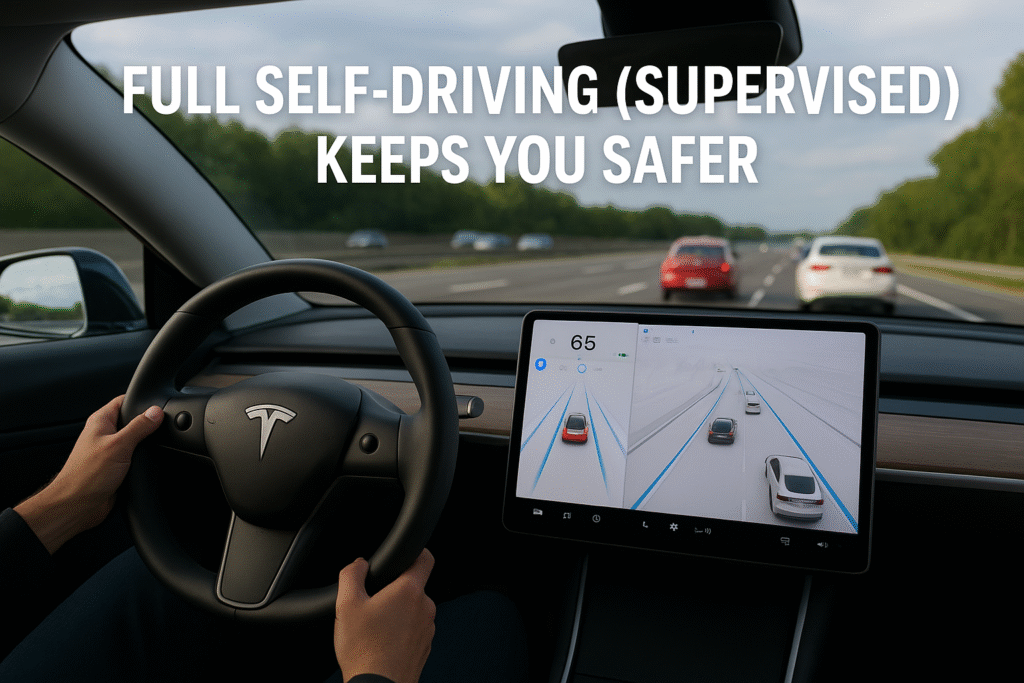
Tesla’s Full Self-Driving (Supervised) feature is an advanced driving assistant designed to handle the driving tasks.
- Lane-keeping
- Highway driving
- Traffic-aware cruise control
- Lane changing
- Automatic braking
- Navigation on Autopilot
- Traffic light and stop sign recognition
- Parking assist
Tesla’s FSD uses a vision-based neural network, similar to how people drive using their eyes and cognitive ability, in contrast to conventional autonomous systems that rely on pre-programmed maps or sensors. Even in its supervised version, it will significantly reduce the driving workload and also improve safety.
Why Safety Matters: Human Error vs. AI Driving
According to the reports we receive from Global City, the majority of road accidents are caused by human error, such as drivers sometimes being distracted while driving at high speed, fatigue, illness, or other mistakes. Tesla’s self-driving system will address these issues.
| Human Weakness |
| Fatigue and slow reaction |
| Distracted driving |
| Aggressive or emotional driving |
| Limited night visibility |
| Misjudging distance |
| FSD Strength |
| Always alert, reacts instantly |
| Maintains full environmental awareness |
| Predictable, rule-based maneuvers |
| Advanced camera perception and sensors |
| Precise measurement and calculations |
Our purpose in explaining this to the company is to show that the self-intelligence in FSD will provide us with an extra layer of security.

How FSD (Supervised) Keeps You Safer
How FSD (Supervised) Keeps You Safer
Real-time sensor systems will make intelligence smarter and more secure. We will explain some of the techniques for explaining the score in the following paragraphs.
1. We will use neural networks and techniques that will help us stay ahead in the future.
The FSD system will anticipate the event before it happens and react accordingly before the danger arises.
An example of this is that if a car is approaching us very quickly from behind, this system will detect that car and change lanes.
If a pedestrian is crossing the road, this system will anticipate it and automatically stop the car.
This system will make decisions very quickly in terms of decision-making and awareness.
2. 360-degree camera will be installed in English.
In contrast to people who would periodically check their mirrors, Tesla’s system:
- Monitors all surroundings 24/7
- Tracks speed, distance, lane markings, and objects
- Uses multiple cameras and sensors simultaneously
This makes it extremely effective at detecting:
- Blind-spot hazards
- Sudden lane intrusions
- Small roadside objects
- Motorcycles and cyclists
3. Automatic Emergency Response and Crash Avoidance
To avoid collisions, Tesla’s FSD employs sophisticated algorithms:
• Correction of lane departure.
Automatic braking and collision avoidance
When an automobile abruptly stops ahead, for instance, the system reacts more quickly than a person would, greatly lowering the chance of a collision.
4. Enhanced Consistency in Driving
Whenever humans drive, they have some good days and some bad days; that’s just how it is for people.
But when a Tesla drives, every day will be the same.
Because with the FSD system, it will follow the rules made for cars and keep us safe. And it will also prevent the mistakes that happen daily.
5. Easy Navigation in Complicated Settings
Tesla’s FSD is particularly useful when there is
heavy traffic
traffic connects.
roundabouts,
stop-and-go traffic,
unmarked roads,
urban crossroads
The role of supervision: How much does Tesla still need human intervention?
Despite the system being highly advanced, Tesla calls it “supervised” because:
- Construction zones require flexible interpretation;
- Roads can be unpredictable;
- Weather can obstruct camera vision; and the AI continues to learn from real-world data.
Even with minimal cognitive strain, the driver must remain alert and ready to take control.
In other words, FSD makes drivers safer, smarter, and more comfortable without completely replacing them.
Real-World Safety Results
Tesla’s quarterly safety statistics consistently show:
- Lower collision rates compared to conventional driving;
- Fewer accidents per mile when FSD and Autopilot are activated.
Drivers who use FSD (Supervised) feel more confident, especially when traveling long distances, merging onto and exiting highways, and driving late at night.
Driving Fully Autonomously in the Future
Through over-the-air software upgrades, Tesla keeps enhancing FSD, so the car becomes:
- Safer
- Smarter
- More efficient
Without needing hardware replacements.
As AI evolves, supervised mode is expected to transition toward full Level-5 autonomous driving — where the car handles everything without human input.
This could reshape:
- Ride-sharing
- Long-distance transport
- Traffic safety laws
- Insurance policies
- Automotive design


